
The modern Olympic movement owes its roots to the ancient Olympic Games, which were held in Olympia in the Peloponnese, a sanctuary dedicated to the god Zeus.
There is no reliable data on the origin of the Olympic Games, and the oldest written record dates back to 776 BC.
However, the first known winner, Koroibos, was a contemporary of Socrates (around 400 BC), but it is believed that those who estimate that the first Games of the ancient era were held around 1,500 years before Christ are closer to the truth.
This is supported by a text found on a disk excavated in Olympia: “Asklepiades, a pentathlete, dedicates this disk to Zeus at the 225th Olympiad”…
Given that the Games were held every four years, it is clear that their origin goes much further back than 776 BC and Aristotle’s claim that they were founded then by Iphitos of Elis.
Olympic sports in ancient Greece included short- and long-distance running, wrestling, boxing, pankration (a combination of wrestling and boxing), pentathlon (running, long jump, discus throw, javelin throw, wrestling) and horse races, and during the Games a truce was proclaimed and Greek city-states suspended wars.
The Games were abolished by the Roman Emperor Theodosius II in 394 AD due to their pagan origin, and the revival of the Games in the modern era and the founding of the International Olympic Committee and the Olympic movement was initiated by the Frenchman Baron Pierre de Coubertin at the end of the 19th century.
An enthusiastic athlete, educator and historian, inspired by excavations in ancient Olympia, as well as the revival of the sports movement in many countries, at a meeting of the Union of French Athletic Sports Societies in 1892, he first advocated the revival of the Olympic Games as “periodic sports competitions of the youth of the whole world that would contribute to eliminating national rivalry and disagreements of a religious, political and racial nature”.
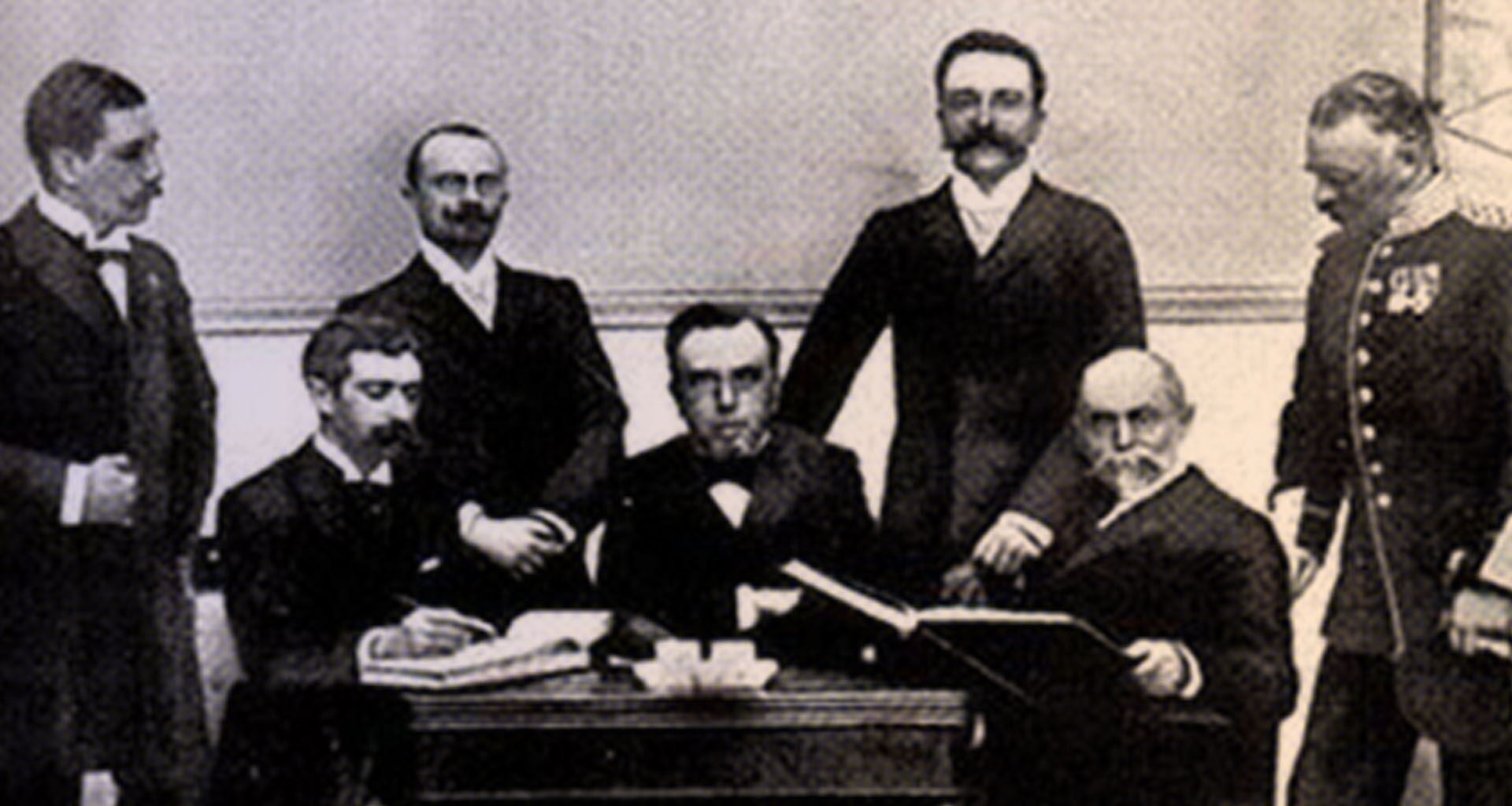
At the same gathering the following year (August 1, 1893), at Coubertin’s proposal, the World Sports Congress was convened, and on June 16, 1894, it began as the Founding Congress of the International Olympic Committee.
The Congress was attended by 79 delegates from 49 sports organizations from 12 countries, and representatives (as observers) from another 21 countries.
The IOC was constituted on the eighth day of the session – June 23. It had 15 members from 12 founding countries (Argentina, Belgium, Great Britain, Greece, Italy, Hungary, New Zealand, Russia, USA, France, Czech Republic, Sweden), and the first IOC members were organizers of Olympic committees in their countries.
Members of the first IOC included V. G. Balck (Sweden), F. Kemeny (Hungary), D. Vikelas (Greece), A. D. Butovsky (Russia), Baron P. de Coubertin and E. Callot (France), Duke Lucchesi Palli and Count D’Andria Carafa (Italy), J. Guth-Jarkovsky (Czech Republic), L. A. Cuff (New Zealand), Lord L. Ampthill and C. Herbert (Great Britain), H. B. Zubiaur (Argentina), W. Sloane (USA) and Count M. de Bousies (Belgium).
The following year, German V. Gebhardt also became an IOC member.
It was decided that the Games would be held every four years, that the first Games of the modern era would be held in Athens in 1896, and that the first IOC president would be Dimitrios Vikelas, representing the host country of the first Games, while Coubertin accepted the position of Secretary General (he became IOC president after the Athens Games in 1896 as a representative of the new host country, France, and remained in that position until 1925).
The Congress also adopted the Olympic Rules (today the Olympic Charter), which underwent many changes during the past century.
In short, the Rules stated:
- (Article 1) that it is in the interest of the International Congress and all countries to revive the Olympic Games in a modern form while adhering to classical principles;
- (Article 2) that sports federations of all “civilized countries” should be invited to the Games and that countries may be represented only by their citizens;
- (Article 3) that the Olympic Games would include athletics, water sports, skating, fencing, wrestling, boxing, shooting, gymnastics, cycling and equestrian sports;
- (Article 4) that only amateurs may participate;
- (Article 5) that the organizing committee may exclude participants;
- (Article 6) that a pentathlon shall be organized.
Today, the International Olympic Committee and the Olympic movement bring together more countries and territories than the United Nations; the Summer Olympic Games are by far the most important global sporting event, while the Winter Olympic Games, launched in 1924, follow closely behind.